La Salle University
At La Salle University, Koh McGinn, ‘26, M.S. ‘27, has thrived as a student in the Communication Sciences and Disorders 5-year Program, finding community on campus along the way.
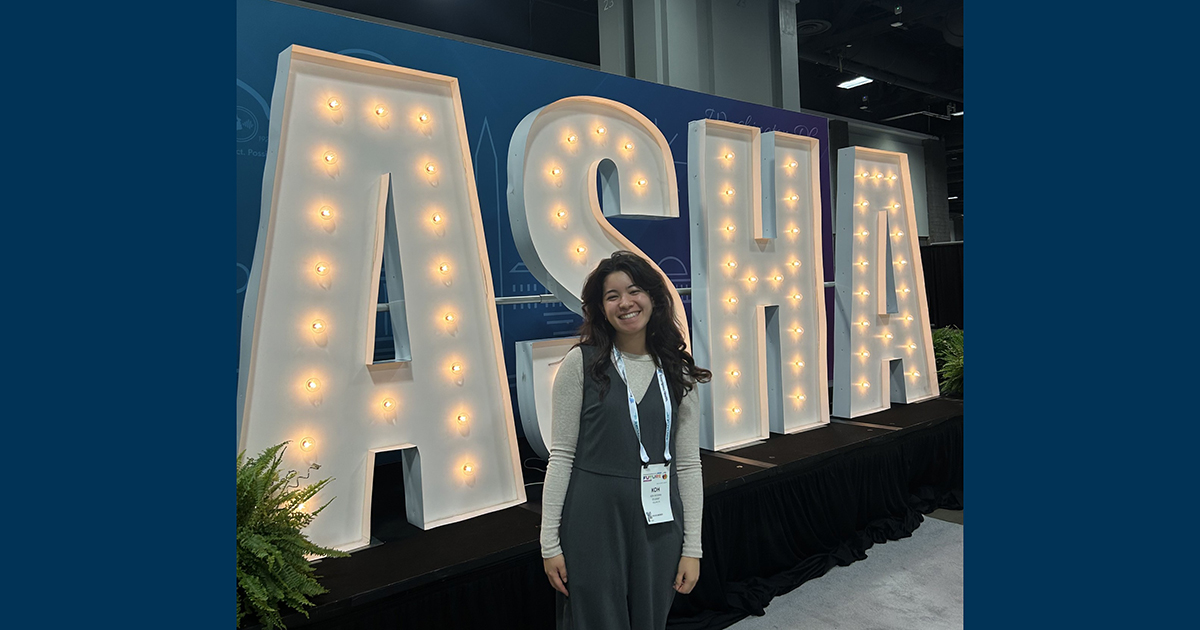
Koh McGinn, ’26, M.S. ’27, had the opportunity to present research at the 2025 American Speech-Language-Hearing Association (ASHA) Conference, were she was the recipient of a Progeny Award.
Koh McGinn, ’26, M.S. ’27 was introduced to the world of speech language pathology at an early age when she began seeing a speech therapist around the fourth grade.
“At first I wasn’t fond of it,” she said. “But I eventually started appreciating it and the role of a speech therapist.”
For McGinn, this personal childhood experience sparked an interest in the field. Now, as she prepares to start her final year in La Salle University’s Communication Sciences and Disorders 5-year Program, her education is helping turn that interest into a career.
When looking at colleges, La Salle’s academic offerings appealed to McGinn. She liked both the Honors Program, which she is now part of, and the Communication Sciences and Disorders 5-year Program, which students graduate from with both a bachelor’s and master’s degree in speech language pathology.
“The whole Speech Language Pathology Program is accelerated, and there was reliable information that I would be able to be successful in that profession by going to La Salle,” McGinn said, adding that she knew she’d be able to get all the clinical hours she needed and pass standardized tests and exams because of the program’s positive outcome data.
McGinn, who is also a resident assistant (RA) and member of the National Student Speech Language Hearing Association (NSSLHA), credits the small class sizes in her program with allowing her to excel, as well as create bonds with her classmates.
“Being in the 5-year program, there’s only eight of us, and I think that’s the reason I’ve been such a successful student,” she said. “Being able to rely on friends and the community within that, just being able to talk about frustrations, or talking through something like the process of swallowing, that kind of thing, that’s been really appreciated.”
The community extends beyond her classmates to the program faculty as well. They work with Explorers to make sure they succeed, McGinn said, and are always available and in contact with students who need help and support.
“The communication aspect of it all is really important,” McGinn said. “And I think it’s very prioritized.”
The support she had from faculty members was evident to McGinn in 2025, when she attended the American Speech-Language-Hearing Association (ASHA) conference. ASHA is the national professional, scientific, and credentialing association for the industry.
“It was really nice because I was recognized for something,” she said. “And I was able to bond with people over a very niche thing.”
At the conference, McGinn was the recipient of a Progeny Award. Progeny Awards are given to students across the country studying communication sciences and disorders for research projects, which they also have the opportunity to present at the national conference. Award winners are connected with an established member of the ASHA community in the area of their research. McGinn’s winning project focused on bilingualism.
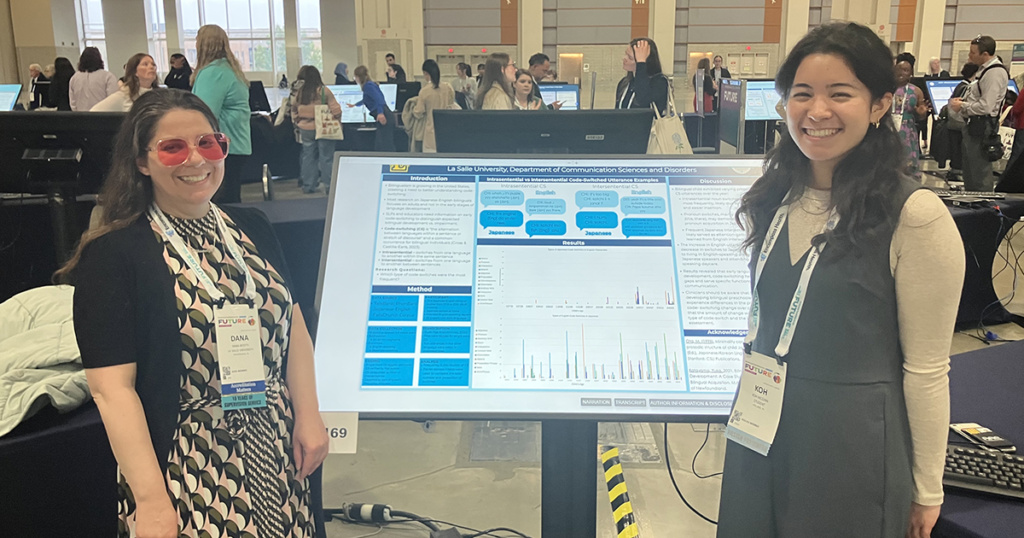
“I couldn’t have done that without the hard work of my advisor / professor,” she said. McGinn’s advisor is Dana Bitetti, Ph.D., CCC-SLP, director of La Salle’s graduate Speech Language Pathology Program. “That was definitely an experience that’s kind of unforgettable.”
As well as the community within the program, La Salle’s Communication Sciences and Disorders Program also has an edge when it comes to clinicals. Students start them a year earlier than most other schools, McGinn said, which is a unique and helpful part of the program.
“We were fortunate enough to just have one client before that and kind of got familiar with what it feels like to be a clinician, how to do data tracking and note taking and what works and what doesn’t,” she said. “That was kind of like a dip your toes in the water type experience which I’m very appreciative of.”
As someone who always wanted to work with children in a one-on-one setting, but didn’t want to be a teacher, McGinn’s journey in speech therapy is allowing her to do just that. La Salle’s curriculum and clinical experiences are preparing McGinn with real-world applications for this goal.
McGinn is currently completing a clinical rotation in private practice, where she works primarily but not exclusively with nonverbal autistic children. A big part of her time in her clinical is spent working on augmentative alternative communication devices, things like trying to help make the children get comfortable using their talking devices, she said, but she’s also been able to get experience helping with other areas, like feeding issues.
Although she’s now working with children, fulfilling her initial goals when it came to her career as a speech therapist, McGinn’s ideas about her future have changed. Her time in the Honors Program has led to some interest in becoming a Fulbright Scholar.
“More realistically, I’m probably going to try to get a job in the medical field, hopefully an acute care situation,” she said. “In terms of my program, they’re definitely preparing me to be the best clinician I can be. And they highly emphasize what’s required of you, and what’s ethical, and what the latest effective treatments are, those kinds of things.”
Beyond preparation for the future and the academic community she’s built, McGinn credits her time at 20th and Olney with guiding her to become a better overall student.
“I went to a very big school for high school, and I think going to a smaller school has allowed me to become a better and more successful student,” she said.
That close-knit community is one of La Salle’s best features, McGinn thinks.
“I was not expecting to make all the types of relationships with people that, honestly, I don’t think I ever would have made if I went to a bigger school. I know it’s cliche, but it’s true,” she said. “That community aspect of just being able to literally know everyone that you walk past going from your dorm to the Union is really something special.”
-Naomi Thomas