La Salle University
Throughout her career as a mathematics educator, Abbey Howard, Ph.D., has focused on making the subject as accessible as possible for students, drawing from her personal experiences as inspiration.
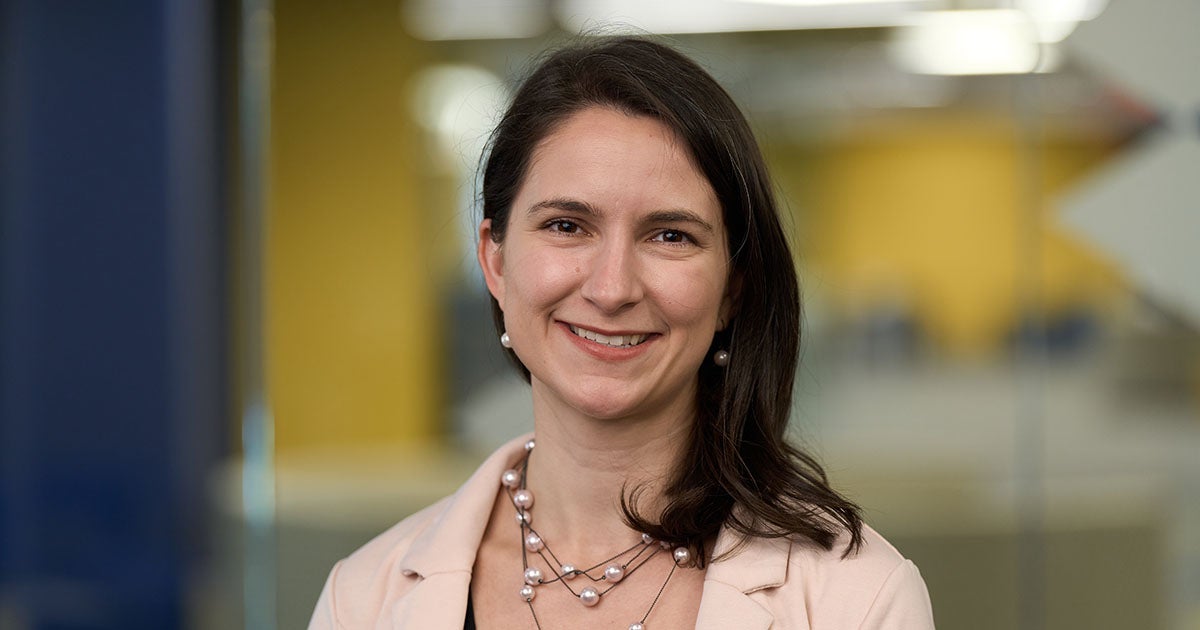
The culture at La Salle is one of Howard’s Explorer highlights, she said, adding that she is part of a community that “truly lives its mission” and has taught her how to be student-centered without sacrificing content.
Abbey Howard, Ph.D., had to work hard at mathematics when she was a student. Although she’s loved the logic and reasoning that come with numbers and equations since childhood, it often took perseverance and focus for her to get an answer.
“Mathematics did not come naturally to me. I had to work hard to develop my understanding, and that experience shaped my approach to teaching,” the assistant professor of mathematics said. “Because I had to find ways to make mathematics make sense for myself, I became passionate about helping others to do the same.”
It was as an undergraduate at Drexel University majoring in secondary education for mathematics that she first realized that it was learning how to understand mathematics that really interested her. That, combined with her personal experiences, led her down the path to becoming a mathematics educator.
After graduating with her bachelor’s degree and earning a Master of Science in teaching, learning, and curriculum from Drexel, Howard began her teaching career, holding teaching roles at various institutions including Temple University, Pennsylvania State University Abington, and The Community College of Philadelphia. She also earned her doctorate in mathematics and science education from Temple University.
A decade into her teaching career, Howard was exploring new opportunities and came across La Salle, joining the School of Arts and Sciences as an assistant professor of mathematics.
When she first became an Explorer, she didn’t think it was possible for the community to be as welcoming and supportive as they were.
“Four years later, I’ve learned that it isn’t too good to be true. It’s simply the culture,” she said. “Looking back, I truly feel as though I was meant to end up here.”
That culture is one of Howard’s Explorer highlights, she said, adding that she is part of a community that “truly lives its mission” and has taught her how to be student-centered without sacrificing content.
Every student is treated as an individual, with their own goals, challenges, and strengths, she said, adding that the environment allows for the relationships between the teachers and learners to become central to the overall educational experience.
“I deeply value that approach,” she said. “It reflects my mission of being both caring and demanding, supporting students while also encouraging them to reach their full potential.”
Howard credits the late Br. Bob Kinzler, FSC, with inspiring that mission. After first hearing Br. Bob use the phrase “caring and demanding” at her first fall convocation, she wrote it on a sticky note which she has kept on her desk as a reminder since.
Throughout her four years at 20th and Olney, Howard has stayed true to her goals, creating and adapting classes and resources to help her students thrive.
As part of a group of faculty, Howard helped to develop the course, MTH III: Foundations of Algebra, after noticing that many students who were placed in College Algebra needed additional foundational skills. Instead of requiring remedial classes that would delay graduation, she and the mathematics department built those lessons into the curriculum of the College Algebra course, through an additional credit hour.
“The goal is simple,” she said. “Remove unnecessary barriers and give students the support they need to succeed without slowing their academic momentum.”
Howard is also a big proponent of Open Educational Resources (OER) and has been working over the past several years to transition multiple of the courses she teaches to apply them.
OER utilizes free education resources, for example textbooks and instructional materials, to help reduce additional costs and financial barriers for students and their teachers. Beyond just the cost benefits, OER also gives faculty more flexibility in customizing their materials and resources to align with the specific needs of their students.
College Algebra, a course the Howard teaches most fall semesters, is now completely OER based. Being able to teach this class to students with all the resources that OER makes possible and then see many of those same students in the spring semester in more advanced classes, means that she can see their progression throughout their college years.
“Watching students grow over time is incredibly rewarding,” she said. “Some of the best moments happen when students suddenly recognize how concepts fit together and how mathematics applies to fields and interests they genuinely care about. Seeing that growth in both understanding and confidence is one of the most satisfying parts of teaching.”
No matter the class she’s teaching though, the most fulfilling thing about her job has remained the same: helping her students gain confidence in the field.
“Many people believe they simply are not ‘math people,’ and I enjoy challenging that assumption,” she said. “There’s nothing more rewarding than seeing a student who once doubted their abilities experience the moment when everything clicks.”
As well as her own dedication to her classes, Howard also credits the rest of the faculty in the School of Arts and Sciences and the Department of Mathematics and Computer Science with creating an environment where both she and her students can thrive.
“Teaching can sometimes feel like an individual endeavor, but at La Salle it truly feels like a team effort,” she said. “Whether we’re sharing ideas, troubleshooting challenges, developing new initiatives, or simply supporting one another, my colleagues play a significant role in my success and our students’ success.”
–Naomi Thomas