La Salle University
A collaborative faculty student research project gave computer science majors Tannah Duncan, ‘27, and Ilia Volkov, ‘27, the chance to see how what they were learning in the classroom could help address tanking, one of the NBA’s biggest problems.
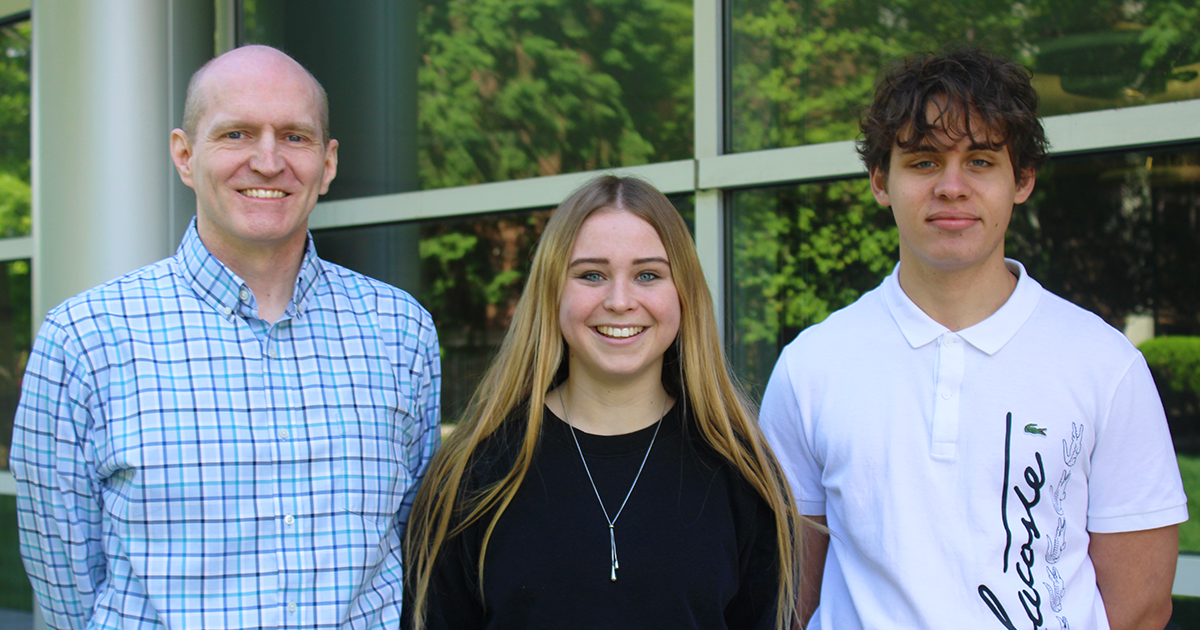
A summer research project turned into a year-long learning experience for computer science majors Tannah Duncan, ‘27, and Ilia Volkov, ‘27, who through their work have proposed a potential solution for a problem the NBA has been facing for decades: tanking.
Duncan and Volkov spent the fall and spring semesters working with Timothy (T.J.) Highley, Jr., Ph.D., chair of La Salle’s Math and Computer Science Department on the preprint Carry-Over Lottery Allocation: Practical Incentive-Compatible Drafts, which identified a method, referred to as COLA, that the NBA could use to discourage teams who may intentionally lose games to land a better position in the draft.
Tanking, or when teams either shut down or sit players for games, is something that the NBA has been trying to prevent for a long time. Although the NBA approved a different new draft method in late May 2026, completing the research project provided Duncan and Volkov with a valuable learning experience.
“I am always looking for ways to gain experience and get involved; however, I had never really thought about undergraduate research,” Duncan said. “Computer science, mathematics, and sports have always been things I am interested in, so learning that we would be combining all aspects of my interests was very exciting. It started as a summer research opportunity but ultimately became a complete learning experience.”
For Volkov, who wasn’t initially a big basketball fan, it sparked new interest in how math and data can both be used to study and address real-world problems in the sports world.
Both of the students were involved in all parts of the research, but they had a particular focus on the coding and simulations that were involved in validating their new method.
“I was building everything for all the graphs and statistics,” Volkov said, noting that the team built the project from scratch. “It was interesting to see the results and all those graphs, to see that my simulation actually works and gives good results.”
Building that simulation model stood out to Volkov, becoming one of his favorite parts of the “great” experience, alongside learning about basketball analytics, social choice, and research methods.
Duncan described completing the research as “extremely rewarding and beneficial,” saying that it enhanced her overall higher education experience.
“It allowed me to apply what I learned in the classroom in a practical way,” she said. “It was exciting to see the connection between what I learned in class and what we were using in the research.”
The real-world aspect of the project was also highly beneficial for Volkov, who now has a much more practical and meaningful understanding of research.
“The most valuable thing I gained was learning how to think mathematically about social and real-world problems,” he said. “The experience showed me how data and modeling can help explain and improve complex decisions.”
The collaborative nature of researching, developing, and testing COLA played a big part in the success of the projects.
“Tannah and Ilia were great to work with,” Highley said, noting that this collaboration gave the students the opportunity to have an experience that they wouldn’t get from coursework. “They bought a lot of energy, a great attitude, and made it a great experience overall.”
Beyond just the immediate benefits of working on a project like this, it can also help longer term, Highley said, giving students an idea as to whether they want to pursue further research or even graduate studies in the future.
For both students, working on the COLA preprint, which has gone on to receive both local and national media interest, fueled a desire to continue researching and discovering how what they’ve learnt in the classroom can impact the world around them.
“This is definitely something I would like to do again in the future,” Duncan said. “The experience made me more interested in research, data science, and solving real-world problems using computer science and mathematics. I look forward to more opportunities like this in the future.”
— Naomi Thomas