La Salle University
La Salle University’s Speech-Language-Hearing Community Clinics provide a space on campus for speech pathology graduate students to put what they learn in the classroom into practice, building their confidence and professional skills.
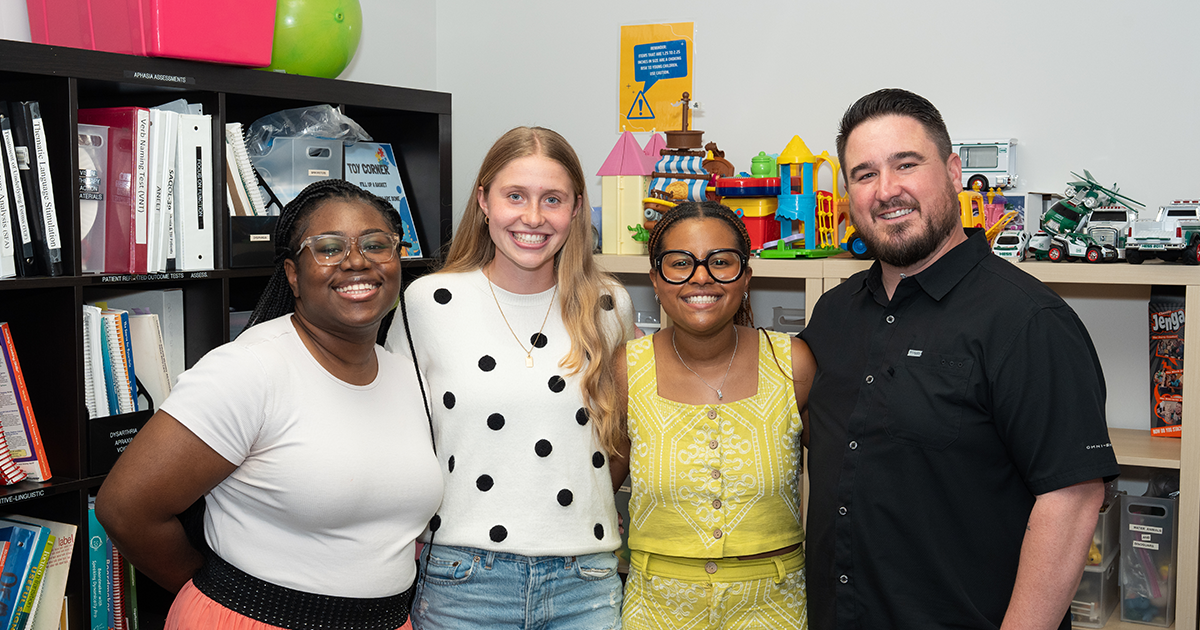
Ella Verello, ‘26, M.S. ‘27, Jai Wells, M.S. ‘27, and Faith Leonard, ‘25, M.S. ‘27, all wanted careers where they could help people. Through different paths, they all landed on becoming speech-language pathologists (SLPs), and in their first year of La Salle University’s Speech-Language Pathology (M.S.) Program, they’re already seeing how they can make a difference in their clients’ lives.
The La Salle University Speech-Language-Hearing Community Clinics play a big part in that.
These are on-campus training clinics where graduate students can provide services to community members of all ages, acting as the primary clinicians under the supervision and guidance of licensed SLPs.
“The clinic is a central part of their training and is integrated into their coursework,” Kris Ralph, CCC-SLP, director of the clinics, said, adding that it’s an environment where the students can use their knowledge base in the real world. “Instead of only learning theory in the classroom, they apply those concepts in actual therapy. They learn how to build rapport, problem-solve in the moment, adapt activities, write professional documentation, and collaborate with supervisors. It helps them grow in confidence and clinical decision-making.”
While campus clinics are common for graduate programs, as clinical hours are needed to complete the clinical standards, La Salle’s donation-based payment model sets it apart from other institutions.
“La Salle is a little different in that our clinic is completely free of charge,” Ralph said. “That approach reflects the Lasallian mission of service and giving back to the community and it allows us to reach families and individuals who might not otherwise be able to access care.”
Verello, who is in the Communication Sciences and Disorders, B.S./M.S. (5-year) Program, noted that the clinic was an integral part to her becoming an Explorer.
“Knowing that we have an on-campus clinic played a role in my decision and further confirmed that this program was right for me,” she said.
She’s already seeing the benefits of having that resource as part of her education.
“I am gaining hands-on practice that reflects what I’ll do as an SLP,” she said. “This experience is helping me develop both my clinical skills and professional confidence, while also allowing me to learn how to tailor interventions to meet each client’s unique needs.”
Students get to work with clients of all ages in the clinics, from toddlers to older adults, providing a wide range of experience throughout the program. While this does sometimes come with challenges—Leonard noted that most of her clients have been adults, an age group she had no prior experience with—it also has positives. It can help the students either reaffirm or decide the age group they hope to eventually work with, and it means that they broaden their knowledge base to include all ages.
Often the first clinical experience students have comes with some nervousness, but the Explorers credit the constant support of the faculty and staff who work at the clinic with helping them overcome those challenges when they face them.
“It wasn’t like we were just thrown in with no warning,” Leonard said. “I’m in the deep end, but I have floaties and my life vest around me and I can pull on the string for help if I need to.”
Starting with one client in their first semester, the students can work with as many as 10 during the following semesters. Their sessions are structured like typical speech therapy sessions: finding out how their client is, making them comfortable, completing activities, and going over their performance.
As the semester goes on, the students are able to see their work in real -time as their clients progress, which in turn adds to their own faith in their professional abilities.
“We’ve been able to watch them grow in the areas we’ve been working on,” Wells said. “I’ve also seen myself grow in confidence.”
The students also learn how to take what they learn from one client and apply it to others.
“In a session, you’re taking it all in, not just for that person, but for all the other people that you’ll have after that,” Wells said.
Throughout everything they learn in the clinic, one thing sticks out to Verello, Leonard, and Wells, which makes it all worthwhile. The difference they can make in their clients’ lives.
For Verello, it’s a reinforcement of her career choice.
“My favorite part is seeing the progress my clients make over time,” she said. “Watching them gain new skills, confidence, and independence is incredibly rewarding and reinforces why I chose this field.”
Wells likes building relationships with her clients.
“I like getting to the point where we can laugh at jokes together, I like getting to the comfortable part,” she said. “And I like seeing them feel like they’ve grown, that makes me feel great.”
Leonard agreed and added that their clients’ emotions reflect back on her.
“The happiness and the joy that they feel when they feel accomplished, I really enjoy that,” she said.
— Naomi Thomas