La Salle University
La Salle sparked a passion for chemistry in Naomi Halas, Ph.D., HON ‘07, ‘80.
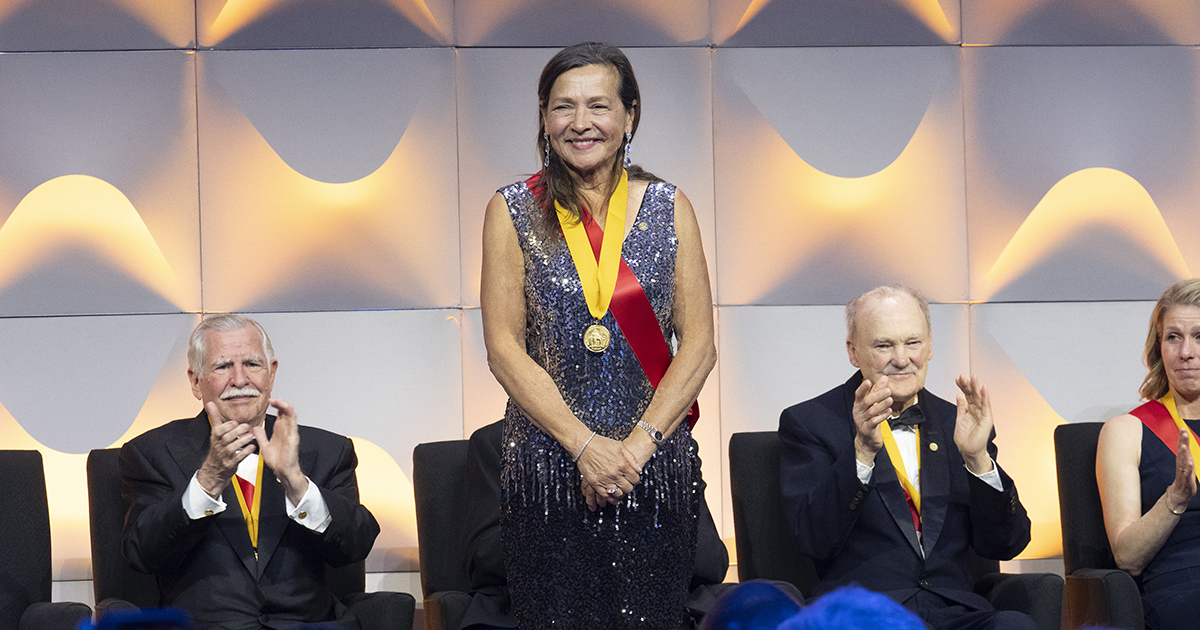
Halas was awarded the 2025 Franklin Medical in Chemistry from Philadelphia’s Franklin Institute in April, where she was honored alongside other recipients. (Photo courtesy of the Franklin Institute.)
The 2025 Franklin Medal Laureate in Chemistry Naomi Halas, Ph.D., HON ‘07, ‘80, fell in love with chemistry at La Salle University. That love has led to prestigious awards, a career in research and teaching, and transformative discoveries in treatments for prostate cancer.
Halas’ path to her eventual career was unusual. After spending two years as a music major at the University of Miami, she realized that it wasn’t the right career path for her. She took a year off, moving to Philadelphia where her sister was a student at the time and living in the area.
“During my year off, I decided that I wanted to go back to school and study pre-med, and everyone I ran into recommended La Salle. I lived in Germantown at the time, so it was an easy commute to a school that was highly regarded across the city,” she said. “It was only after I started at La Salle that I fell in love with chemistry and decided that would be my major.”
Earning her bachelors degree in chemistry took hard work. Because of the years she’d already spent as an undergraduate, Halas had to double up on a lot of her science courses and attend summer classes. Her social circle consisted mostly of students in her classes, whose camaraderie and work ethic she valued greatly and helped to prepare her for her future career.
The Chemistry Department provided an “absolutely outstanding undergraduate experience,” Halas said, as well as the chance to learn from and with the other students and professors. One professor in particular, Thomas Straub, Ph.D., who was a longtime faculty member and chair of La Salle’s Chemistry Department, until his retirement in 2016 when he was awarded the title Professor Emeritus., inspired and encouraged Halas to pursue a career in science beyond her undergraduate degree, she said.
“He was a true mentor and role model in his attitude toward science. His encouragement of me to advance my career beyond an undergraduate degree was extremely confidence-building at the time,” Halas said.
For someone with a schedule so deeply rooted in science, La Salle also offered Halas a different viewpoint that she’s taken with her throughout her life and career.
“I am not sure that I realized it at the time, but it was very meaningful for me to also be able to take philosophy and religion classes in addition to my science-intensive curriculum,” she said. “It is an important aspect of human life to acknowledge a higher power, to realize you are not the center of the universe, and that you have a lot to be thankful for every day. So, I greatly value the religious aspect of my La Salle education.”
After graduating from 20th and Olney, Halas took the knowledge and confidence she gained and applied it first to graduate studies in physics at Bryn Mawr College, where she was offered the opportunity to conduct her PhD research at IBM Research in Yorktown, NY, then to a postdoctoral fellowship at AT&T Bell Labs, before starting as a professor at Rice University in 1990.
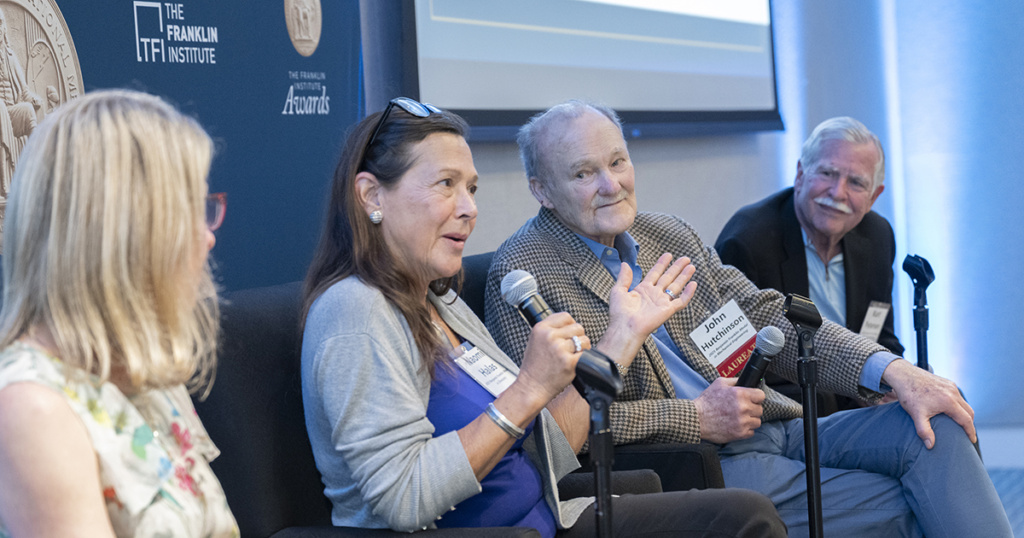
In her time at Rice, she has had over 75 students from her research group earn their Ph.D., and in 2023 she was named a university professor, Rice’s highest professorial rank, which means that although her multidisciplinary lab is based in the Department of Electrical and Computer Engineering, she is recognized as a member of all departments of the university.
Working with her team at her research lab in Houston, Halas discovered how to create nanoshells—tiny nanoparticles that are made from a silica core and a gold shell—that can trap certain types of light and be used in medicine and engineering in many useful ways. The idea of nanoshells was first proposed in the 1950s, Halas said; however, she and her team were the first to successfully develop them.
Halas, with a former collaborator, created the company Nanospectra, which uses her nanoshells in a light-based minimally invasive cancer therapy.
“This therapy has been practiced quite successfully in patients and is now awaiting FDA approval as a procedure that can non-invasively destroy tumors in the prostrate without the deleterious side effects that a great many patients go through,” she said. “As the daughter of a prostate cancer survivor, it’s very satisfying to see our work being used in this way.”
Nanoshells, along with all their applications, are the reason that Halas was awarded the 2025 Franklin Medical in Chemistry from Philadelphia’s Franklin Institute in April, where she was honored alongside other recipients, including Jamie Dimon, CEO and chairman of JPMorgan Chase, who was awarded the 2025 Bower Award for Business Leadership.
“The Franklin Medal Awards week and ceremony were just amazing. It was truly delightful to meet the other laureates, and the Franklin Institute really knows how to throw a celebratory party!” Halas said. “I was also able to host a chemistry symposium where some of my favorite collaborators, colleagues, and even former students made presentations. It was truly great fun, and I am still so humbled by the honor.”
Halas continues her work with nanoshells, although today she is focused more on how to design and engineer closely related nanoparticles that drive chemical reactions with light and not heat, without the use of fossil fuels. This led to her starting a second company, Syzygy Plasmonics and circling back to her days as an Explorer.
“Syzygy Plasmonics has developed a highly promising path to sustainable aviation fuels and the cheapest way to produce hydrogen,” Halas said. “So, I am back to my chemistry roots that started at La Salle, but taking chemistry in entirely new directions using nanoparticles (new ones) and light to drive chemical reactions.”
-Naomi Thomas