La Salle University
Lenten reflection:
April 8, 2025
Lent is a journey. At root, non-believers become Christians. The already-Christians identify with this growing commitment to Jesus, and so they, in support of those to be baptized, pray more and sacrifice more to benefit the needy.
Our ancestors in the faith, the Hebrews, continue their journey of liberation from Egypt. But the journey threatens them, especially in an onslaught of poisonous serpents. Their leader, Moses, prays, and God instructs on eradicating the serpents. The ancient Jewish hymn models confident prayer in the protection of God. Jesus, echoing Moses, is journeying to “heaven,” his home. Yes, Jesus and God are intimate.
The worshipper begs God for help in following God’s will, and also requests more priests, sisters, and brothers—in other words, commitment.
April 10, 2025
What’s in a name?
A lot, but as La Salle is so dynamic and abundant, we strive to know names. We do not probe naming itself or owning our names or adopting new names. My parents named me Joseph, explicitly to honor my mother’s late father. A model to Jews is Joseph, who was betrayed into slavery in Egypt by his very brothers, and yet saved them during famine. This Joseph exemplifies that God, the totally other, surprises us and the miracle of forgiveness. A model to Christians is another Joseph, husband of Mary the mother of God. Both Josephs rely, in faith, on dreams.
Abram worshipped the one God of Jews, Muslims, and Christians. God therefore changed Abram’s name—Abraham—to indicate his obedience and to confirm the gift of enduring nations.
Jesus implies that his intimacy with God goes beyond Abraham’s. Indeed, Jesus uses the name “I AM,” the very self-naming of God in the burning bush to Moses. The ancient Hebrew hymn in this service indicates our duty: Recall God’s double blessing of forgiveness and to living God’s will in love.
What means your name?
Brother Joseph Dougherty, FSC
Looking at the art:
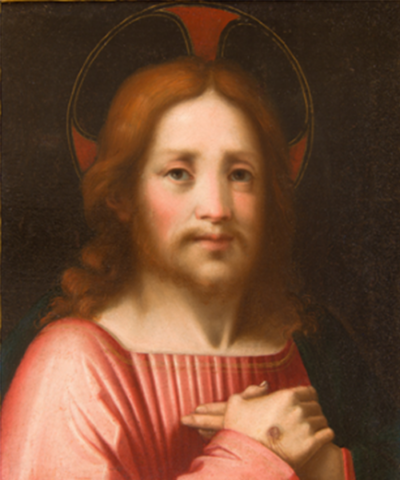
Christ the Redeemer (Basilica della Santissima Annunziata, Florence)
17th Century-18th Century
15 1/4 x 12 3/8 in. (38.7 x 31.4 cm)
After Andrea del Sarto, Italian, (1486–1530)
Object Type: Painting
Creation Place: Europe
Medium and Support: Oil on linen
Accession Number:06-P-527
Current Location: Art Museum : 15-16 C Gallery
This painting of Christ the Redeemer was made after the manner of Andrea del Sarto who was known not only for his High Renaissance frescoes and altarpieces but also for his portraits. Here in the imagination of the painter the crucified and now risen Christ sits for a portrait. Portrait painting, often commissioned, flourished in the 15th century Renaissance to celebrate and honor individual achievement. Christ here is celebrated for the achievement of his redemption of humanity through his own death on the cross and victory over that death. See evidence of that suffering and death in the stigmata on his hand where the nail pierced and attached him to the cross. And imagine him, as the painter does, now risen from death and sitting for his portrait with scars to prove his achievement.
Notice that there is a kind of light haze over the entire canvas. This technique, called sfumato (from the Italian word for smoke, fumo), was common in the Italian Renaissance. Its effect was to soften the transition between colors and tones so seamlessly that brushstrokes could be hard to perceive. Here the added effect is to put a veil of smoke between the viewer and the subject so that a sense of comforting calm is created while viewing this once dead Christ who is now alive. Am I dreaming or is this real?
Not to go unnoticed is the cruciform halo which endows Christ with divine approval. The cross’s arms in the halo are joined behind Christ’s head and serve to replace the crown of thorns. The total effect of this painting is the rendition of a Christ now risen and peaceful after the suffering of his redemptive work has been accomplished.
Reflection
Growing up in a very Polish neighborhood Good Friday and Holy Saturday were always very somber. I remember asking my mother why we didn’t watch TV and why so many things, other than preparing food for Sunday, just didn’t take place. Her answer was that Jesus had died, and just like when someone in your family died there were things you did not do. The same happened on Good Friday and Holy Saturday. While I believe more and more that the cross is central to all we believe, that the crucifixion is what saves us, we have the advantage of knowing what happens next. The Resurrection is the first fruit of the crucifixion. So, it is appropriate that in this fifth week of Lent we contemplate a picture of the resurrected Christ. We know where our Lenten journey is headed. Knowing how the story ends, how our story will end, should give us hope to move forward. Lent is boot camp for life. Every year we voluntarily enter the way of the cross so that when crosses block our path or are handed to us, we do not recoil but carry them as Jesus carried his. The cross is heavy, but in community it becomes easier to bear because we do not bear it alone. Whatever crosses are handed to us, Jesus has already borne them and invites us to come forward with him to enjoy the fruit that the tree of life bears for us, the tree whose leaves are for the healing of the nations, the tree who gladdens us with its saving shade and comfort. Someday, we will all be seated in front of a heavenly artist to have our portraits painted. Will our portraits show the marks of the crucifixion, the mark of the nails or the crown of thorns, or will our image show hands and brows that are unmarked, will it show that we have not borne our cross or the crosses of those who walk with us.