La Salle University
A summer internship at Philadelphia’s Esperanza Health Center helped Yulisa Jimenez Lorenzo, ‘27, grow in both knowledge and confidence as she prepares for her final year of undergraduate education.
Lorenzo credits her education at La Salle with giving her a solid foundation of knowledge from her first day at Esparanza, which she continued to build on through her weeks there. Being in a different healthcare setting from the hospitals she was used to meant that she learned new skills and procedures and grew confidence at performing them.
Nursing major Yulisa Jimenez Lorenzo, ‘27, prioritized gaining experience working in hospitals while studying at La Salle, the environment she wants to build her career in.
However, a summer spent in the IBX Foundation Nursing Internship Program gave her valuable insight into how primary care nursing and non-health related factors can play into her future patients’ health.
Over 10 weeks at the Esperanza Health Center, a primary care clinic in Philadelphia’s Kensington neighborhood, Lorenzo spent much of her time working alongside a physician assistant (PA), helping with same day visits and preparing patients to see their healthcare providers.
“This exposed me to a wide range of concerns and some pretty complex cases,” Lorenzo said. “Many of Esperanza’s patients are uninsured or have limited access to healthcare, so I also saw how things like cost, insurance, transportation, and access to resources can affect the care someone receives.”
Additionally, she had the opportunity to shadow providers from different specialties offered by the Center, including pediatrics, women’s health, and addiction medicine. Not only did this give her valuable insight into how all the departments within the Esperanza Health Center worked together; it also helped change her personal perspectives.
“Before the internship, I had some misconceptions about people struggling with addiction and didn’t realize how difficult recovery really is,” she said, adding that this was one of her biggest takeaways from her summer position. “Hearing their stories and seeing the amount of willpower it takes to stay in recovery really changed my perspective.”
Another takeaway, and a place where Lorenzo really saw her own expertise shine, came from Esperanza’s Spanish speaking clientele.
“Although a translator could be used during visits, I noticed that many patients preferred being able to communicate face-to-face rather than through someone over the phone,” she said. “Since I speak Spanish, I was able to communicate directly with patients and also help the PA I worked with, who was still learning. Seeing how grateful and comfortable patients were when they could communicate directly showed me how important it is for patients to feel understood.”
Lorenzo credits her education at La Salle with giving her a solid foundation of knowledge from her first day at Esparanza, which she continued to build on through her weeks there. Being in a different healthcare setting from the hospitals she was used to meant that she learned new skills and procedures and grew confidence at performing them.
An example of this was getting a patient’s history of present illness (HPI), or the details of what brought them to the Center for care, information that is then used to guide and inform their appointment with their provider.
“In the hospital, I hadn’t had as much experience being the first person to ask what bought the patient in and gather that initial history,” she said. “I did struggle with getting a good HPI at first, but the more I did it, the more comfortable I became knowing what questions to ask and what information was important to include. It was a good opportunity to take what I had learned in school and actually build on it through experience.”
Biweekly visits to Esperanza’s Hunting Park location were another part of Lorenzo’s internship. Here, she helped with the Young at Heart Program, an initiative that gives older adults a place to meet and socialize, gain healthy nutrition tips, and participate in activities.
“I really liked the purpose behind it because it gives older adults a space to connect with others and helps combat loneliness and social isolation,” Lorenzo said.
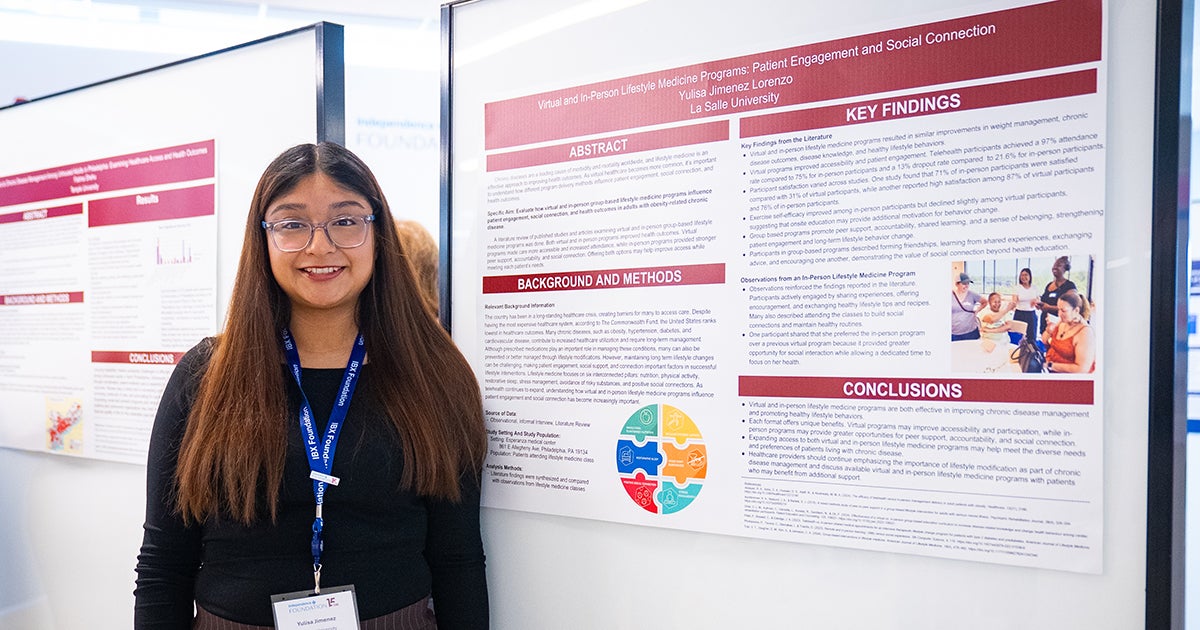
The program, and the lifestyle medicine classes that she helped with, even inspired the research project she completed as part of her internship.
After completing the first class, she heard several attendees talk about how they decided to attend because they were lonely and wanted to find a sense of community, something that really stood out to Lorenzo.
“That made me interested in the social connection part of lifestyle medicine, and whether the way a program is offered makes a difference,” she said.
Her final project investigated how virtual and in-person group-based lifestyle medicine programs affect patient engagement, social connection, and health outcomes.
“Throughout the weeks I also noticed the community that was being built,” Lorenzo said.
On top of a new academic interest, these lifestyle classes also led to many memorable and happy memories from her internship. One positive was the wide variety of people she got to meet, as there were volunteers and attendees from all different backgrounds and stages of their healthcare careers.
“The classes themselves were also really fun and interactive,” she said. “We did small workouts, talked about different nutrition topics, and the cooking portion was my favorite. Everyone participated in making the food together and then we all got to eat what we made. It was always something different that I looked forward to.”
Although she still hopes to go into hospital nursing, Lorenzo gained a lot from her internship.
“Even though I don’t see myself going into primary care, I learned a lot from the experience that I know I can carry with me into nursing,” she said.
She also saw many personal benefits from her time at the Esperanza Health Center.
“At the beginning of the internship, I would second guess myself or wonder if I was asking the right questions, but as the weeks went on, I became more comfortable,” Lorenzo said. “Going into my last year, I think I’ll be more confident speaking up, asking questions, and taking initiative during clinicals instead of always waiting to be told.”
-Naomi Thomas