La Salle University
After 15 years in La Salle University’s History Department and one year into his role as Director of the Honors Program, Lyman Stebbins, Ph.D., is grateful to share his love of learning and the value of a liberal arts education with Explorers.
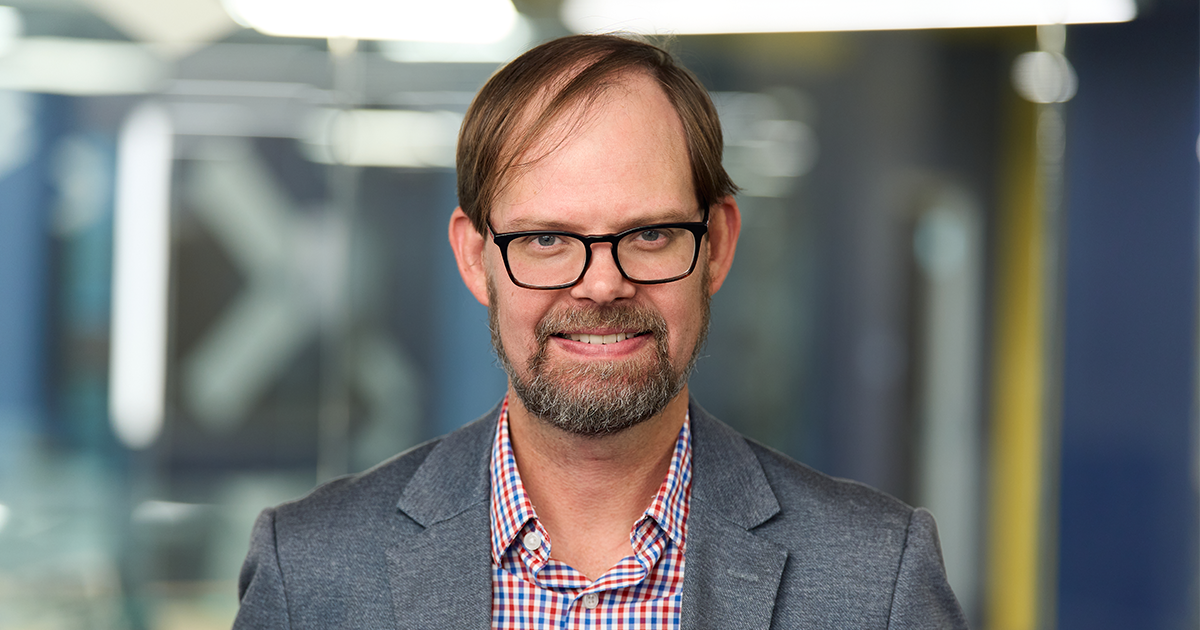
In 2011, having recently earned his doctoral degree from the University of Chicago, Lyman Stebbins, Ph.D., was looking for a place to start his career as a professor. At the same time, the History Department at La Salle University was looking for someone to teach both Middle Eastern and European history, the focus of Stebbins’ work.
“How and why was I hired? Providential good fortune,” Stebbins said about becoming an Explorer. “I’ve studied in Iran, I’ve done research in Britain, that’s the research that bought me to La Salle and continues to inform upper division work and my development as a teacher-scholar.”
Meeting students at the beginning of their own journey is one of his favorite things about his job.
“Students often do not yet have a full understanding of their potential or their interests,” he said. “You get to be there as someone develops a new or different love of learning.”
A couple of years into his tenure at 20th and Olney, Stebbins joined the Honors Program, teaching history as part of the Honors Triple.
The Triple, one of the hallmarks of La Salle’s Honors Program, is a series of six discussion-based classes in philosophy, literature, and history, which along with other Honors courses helps students see interconnections between disciplines and probe big questions about the human experience.
“I was honored to be asked to teach history in the program, and to be mentored by senior faculty who had so much experience doing it, some of whom are still here, which is tremendous,” Stebbins said.
The Honors Program has been a big part of Stebbins’ La Salle experience. He’s continued to teach the history portion of the Triple, he’s taken students on travel-study trips to London, and has joined them on many trips in and around Philadelphia that have complemented what they’re learning in the Program.
“When there was an opening for the directorship a year ago, I thought to myself if you really care about something, you should be willing to serve to do it,” he said. “So, I applied.”
In July 2025, Stebbins became the newest director of La Salle’s Honors Program.
“I have a real sense of the tradition of this thing. Its reputation is stellar: it has a long history of excellence,” he said. “I feel a sense of responsibility toward the program, which has done so much for me.”
Over the last year, Stebbins has learned a lot, he said. All the people he’s met through his newest role, staff and students, are one of the highlights of the past year.
“Getting to know so many great students and to celebrate their success across a wide variety of fields,” he maintained, “has been very exciting.”
He aims to help grow the Honors Program, making this type of liberal arts education available to more people. Stebbins cited the new partnership between La Salle University and Bucks County Community College as just one of the ways this was already happening.
“It’s been really exciting to be directing the program at a critical moment for liberal arts education and to have an opportunity to ensure it’s going to meet the needs of the next generation of students,” he said.
In Stebbins’ opinion, the best word to sum up being able to do this at La Salle is gratitude. He’s met so many people because of his role, works in an environment where he can continue to learn as he’s teaching others, and is a part of a long-standing Lasallian tradition, he said.
“To have a place that has a real sense of what it’s about, what it’s supposed to do, where one’s own personal and professional vocation can merge with an institutional one is pretty remarkable,” he said.
— Naomi Thomas