La Salle University
For Lyla Campeotto, ‘26, and Stella Campeotto, ‘26, La Salle University’s Criminal Justice and Sociology Programs have helped them lay the foundations to build careers that will help people.
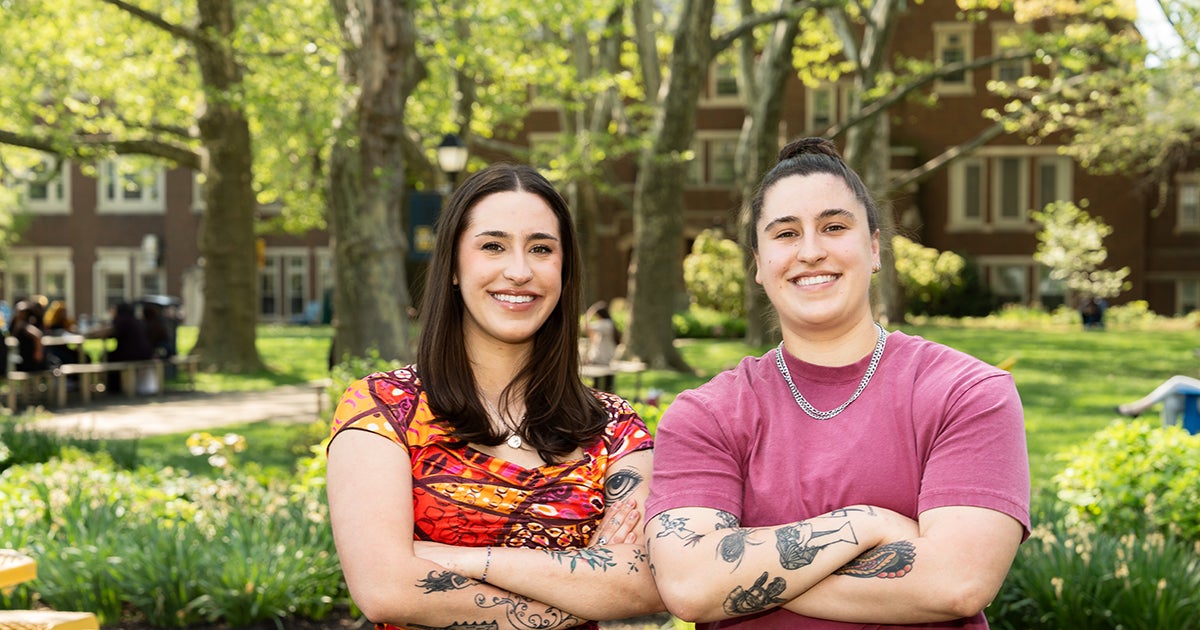
Whatever job they end up doing, Stella (pictured left) and Lyla (pictured right) both know that they want to help others feel valued, supported, and in a position to better themselves, something that they’ve both experienced throughout their four years at La Salle, a place that has given them just as much opportunity to learn about themselves as it has about other people.
For as long as they can remember, Lyla Campeotto, ‘26, and Stella Campeotto, ‘26, have wanted to make positive changes in the world.
“Ever since—for me and Stella both—we were younger, anything that was an injustice felt so infuriating to us,” Lyla said.
La Salle University’s Criminal Justice and Sociology Programs and the opportunities their education has opened for the Campeotto twins set them on the path to address and change those injustices in the future.
Lyla and Stella didn’t start out at 20th and Olney together. Stella didn’t have a particular college in mind when she started the application process. A family friend told her about La Salle, and she liked the Philadelphia location, the close-knit campus community, and the Division I sports teams. After a visit to campus, she was sold and decided to become an Explorer.
While Stella was settling in at La Salle, Lyla was at a nearby university, a place that she quickly realized wasn’t the right fit for her. She started thinking about options, and La Salle was at the forefront of her mind.
“Stella was, of course, right over here at La Salle, so it made it an easy decision to transfer here,” Lyla said.
In their second semester, both the Campeotto’s were on campus enrolled in the Social Work Program. While the social work field is one that would help with their goal to make a difference, both felt that it pigeonholed them into one particular career, and they wanted to learn more before they made that commitment.
Lyla had taken an introduction to sociology class that she thought was “just incredible,” and full of subject matter that fascinated her.
“I think everyone should take some type of sociology class because it teaches you how to navigate the world benefitting other people and understanding different cultures,” she said.
Sociology goes hand in hand with criminal justice; Lyla believes, another major that interested her.
“The attraction of that is doing something that helps people, makes a difference, gives an intervention to marginalized communities, anything like that,” she said.
While Lyla was finding her place in the Sociology and Criminal Justice departments, Stella was considering majoring in political science.
“Lyla declared her major as a criminal justice and sociology, so I was like I’ll do political science and sociology to be different,” Stella said, adding that although she took enough classes to have a minor, she had realized political science wasn’t the right fit for her. “Obviously that failed. I was like I have to be true to myself, I can’t just be doing this because it’s different from her.”
For Stella and Lyla, who both want to do something meaningful and make a difference in people’s lives, sociology and criminal justice would build the perfect foundation.
“And I want to be a perpetual student,” Stella said. “I want to learn about people forever.”
The Campeotto’s quickly found a home in the Criminal Justice and Sociology Programs and are getting everything they want from their education.
“I love to debate, love to talk, love to hear other people’s opinions,” Stella said. “I think sociology, and specifically our department, it really facilitates nice debate, especially when people are willing to say what they think.”
The faculty that creates this environment is a particular standout, and a big part of why Stella and Lyla believe their time at La Salle has been so special.
“Our entire department is great. There’s not one professor I wouldn’t feel comfortable talking to,” Stella said. “They all make me feel like I am smart and capable.”
The faculty members take the time to get to know and understand their students, they said, and constantly act as support systems to help their students achieve their goals.
“I think it’s so powerful being in a classroom with someone that knows you and understands you and is willing to step out and help you become the best version of yourself,” Lyla said. “I know they are all willing to do that.”
Both know that that support will continue long after they’ve graduated and moved into their careers, and that bond is something special that they don’t hear about from their friends who attend different colleges.
“That caring and personal aspect about the department is what has made our entire experience at La Salle as great as it has been,” Stella said.
“Lyla and Stella are both amazing students who elevate class through their discussions and debates,” Kathleen Bogle, Ph.D., professor of sociology and criminal justice said. “They are not afraid to share their views, but they also critically evaluate their own opinions and how they reached their conclusions.”
It’s not just the faculty that have impacted their four years though: the experiences that have been opened up to them have had just as big of an impact.
One of their classes, Inside Out, took them to an off-campus classroom, one inside the Philadelphia Industrial Correction Center (PICC). Here, they were part of a class working and speaking with incarcerated men in the high-security unit.
This class is part of the Inside-Out Prison Exchange Program and is an opportunity for participants to exchange ideas and perceptions about crime and justice, corrections, and imprisonment, that creates a way for everyone involved to gain a deeper understanding of the criminal justice system.
“It was an incredible experience, just for the simple fact of learning how to treat and approach people that have come from different backgrounds and have different experiences,” Lyla said. “I guess the idea of it is maybe scary, but you realize they’re just people. I think it’s a big learning experience to separate what a person has done from them as a person because your actions don’t necessarily make you bad or evil.”
Everyone there was very open about their stories, Lyla said, and the class provided a strong lesson in learning to meet people where they are and treat everyone with kindness and respect.
Stella added that the people that they met in the program, and the things that they shared with the students, have stayed with her.
“I feel like they taught us way more than we taught them,” Stella said. “I think being with people like that gives you so much more of a comprehensive viewpoint of the actions people have done in their lives and why they end up where they have and I feel like that is one of the main things about sociology that we’ve been learning for the past four years.”
A religion class Lyla and Stella took, culminated in a trip to Rome, Italy, in 2024 with three other students for the Synod of Synodality, a meeting of Catholics from across the world that focuses on discussion of topics that are relevant to the church. The entire meeting lasted for a month, and the Explorers were there for a week of it.
The trip gave them a different perspective on Catholicism and the Church, they both said. The reception that they received was wonderful, and learning about other people’s religious journeys was fascinating.
“It was one of the best experiences I’ve ever had,” Stella said. It was particularly powerful, she added, because that was only the second-year women were included in the Synod discussions. La Salle also had a student present the year it began.
“Definitely a very empowering experience, and I feel like I took away the feeling that my voice mattered,” Stella said.
They also got to meet people from the Lasallian community, including two Lasallian women, who joined the students for dinner one evening, one of Lyla’s favorite moments of the trip.
“It was very eye-opening to talk to people that have such opposing viewpoints from me, but we actually had a lot of crossovers with our values and everything like that,” Lyla said. “To learn that we don’t have to have the same religious affiliation to be good people and want the best for everyone around us.”
Stella has also spent her final semester working on a research project with Bogle, that looks at the nature versus nurture debate in regard to twins. While the focus of her paper surprised her, the whole experience was great, she said.
Bogle noted that she’ll be using the data gathered by Stella to inform her classes on the nature versus nurture debate going forward.
Outside the classroom, Stella and Lyla have completed two internships, both of which are full of experiences that they greatly value and helped to guide them going forward.
First, they worked for a semester with the Sentencing Foundation, a program that provides logistical support for Resource Based Sentencing and Supervision. In their roles, Lyla and Stella worked in Philadelphia City Hall under a criminal judge. A big part of the internship was sitting with the judge in the courtroom, where she would ask defendants about their circumstances to establish resources that would help them overcome their obstacles.
“Things that would help them get out of the cycle of incarceration,” Lyla explained. They would also sometimes interview people when they left the courtroom, to see how the program was helping them. Getting to do a final interview with one of the participants was one of the most meaningful parts for Lyla.
“I got to walk in the hallway, ask him a couple of questions, shake his hand and be like ‘okay, bye,’” she said. “That was the last time he would be in the courtroom, which was awesome. It was crazy that I got to be the last person to speak with him, but that was really cool.”
As well as their work in the courtroom, Stella and Lyla were also part of efforts to facilitate relationships between judges and organizations to get the sentencing model in motion in other states.
The second internship, which Stella and Lyla are still currently participating in, is at Matham House, a residential rehabilitation center for 12- to 21-year-old males, who have committed sexual crimes. At Matham House, Stella and Lyla work as youth counsellors, working hand in hand with therapists to monitor the residents.
The name Matham House, Lyla explained, was inspired by a building in the Lord of the Rings, that was described as a place to keep relics that don’t have immediate use but are too precious to be thrown away.
“That’s why it’s called that,” she said. “It’s for teenagers that have done something really wrong, but we’re not going to cast them away, which I think is really awesome.”
While the work can be emotionally draining sometimes because of the circumstances some of the residents have in life, it’s incredibly fulfilling and has given both Campeottos a deeper understanding of how to work with and help people in the best way.
“I feel like it has taught me so much more patience,” Stella said. “It definitely makes you a more patient, a lot more understanding of people and the things that they have been through.”
As they look to life post-graduation, Lyla plans to continue working at Matham House as she works on starting her career. While she doesn’t know exactly what she wants to do, her main aim is to help people.
“My dream job is to do something hopefully helping people that were formerly incarcerated, giving them resources, treating them with kindness,” she said. “Something to help better the world. That’s my goal.”
Her desire to work in the re-entry field goes back to the lifelong want to fix injustices, she said. Learning about the criminal justice system and how, in her opinion, it’s not serving its purpose, has just stoked that.
“It gets me fired up, I want to do something about it,” she said. “I think that’s my motivation, seeing an injustice and wanting to do something about it.”
Like Lyla, Stella also wants to work somewhere in the realm of re-entry. Unlike Lyla, though, she’ll be doing that in Charleston, S.C., where she’s moving in the months after Commencement.
“I don’t want to be a probation officer because I don’t want to put people back in prison or jail,” she said. “I want to be the good part of someone’s day, that’s definitely my goal and I want them to feel like I really care about them, so that’s what I strive for. That’s my goal.”
Whatever job they end up doing, Stella and Lyla both know that they want to help others feel valued, supported, and in a position to better themselves, something that they’ve both experienced throughout their four years at La Salle, a place that has given them just as much opportunity to learn about themselves as it has about other people.
“I learned how to be a better person, a more well-rounded individual,” Lyla said.
“Being in college and being able to learn from other people around you, not just your professors, learn about who you are as a person, who you are as a friend, I think that is the most valuable thing we got out of being at La Salle,” Stella added.
–Naomi Thomas