La Salle University

Business Systems and Analytics (M.S.)
- Master's Program
- 1-year, Hybrid, On Campus, Online
Program Snapshot



What you’ll learn
La Salle’s M.S. in Business Systems and Analytics is a flexible 30–34 credit program designed for students from diverse academic and professional backgrounds. The curriculum emphasizes data-driven problem solving built around five integrated components: pre‑program coursework, business, data, systems, and managerial perspectives.
Through a multidisciplinary mix of analytics, business, and leadership courses, supported by faculty expertise and industry engagement, students gain the practical skills needed to apply business analytics and data science in today’s organizations.
Why pursue Business Systems and Analytics at La Salle?
Our program is designed for the working professional. Courses are available online, in hybrid formats, and in the evening to fit around regular business hour schedules. Courses are taught in an accelerated eight‑week terms so students can focus on one subject at a time. With our flexible model, students can finish the program in as little as one year (three semesters of coursework) or over approximately two years on a part‑time schedule. Whether you are a recent graduate, a career changer, or seeking advancement, La Salle’s Business Systems and Analytics programs are designed to meet you where you are.
Most recently, La Salle’s School of Business was ranked in the Top 100 in the nation by U.S. News & World Report, only 1 of 2 in the Philadelphia area to make the list. At La Salle, you’ll be part of a university growing in stature while getting the hands-on, personalized support you can expect from a university rooted in community.
If you’d like to explore our innovative curriculum in depth, please click below to view our academic catalog.
Highlighted Courses
BSA 720: Data Warehousing and Data Mining
This course focuses on data warehousing and data mining in organizations. Topics covered in the course include: data warehousing and mediation techniques aimed at integrating distributed, heterogeneous data sources; data mining techniques such as rule-based learning, decision trees, association rule mining, and statistical analysis for discovery of patterns in the integrated data; and evaluation and interpretation of the mined patterns using visualization techniques.
MKT 730: Strategic Marketing Analytics
This course introduces today’s most valuable marketing research and analytics methods and tools and offers a best-practice methodology for successful implementation. Hands on projects and case studies provide students an opportunity to apply the marketing research and analytics techniques for solving key problems, ranging from product development, segmentation, pricing, campaign management, brand valuation, and digital marketing strategy.
MBA 820: Information Technology for Decision Making
This course is about the manager’s responsibilities for problem solving and decision making, and those areas in which information technology can be used to gain the insight needed to support selection of decision alternatives. Students learn about the role of data, information and knowledge in managerial problem solving and decision making. Transactional processing and database management systems (DBMS) are used to store, manage and retrieve data in organizations. Decision support system (DSS) tools and technologies (such as natural language programming and influence diagramming) are used to organize data into information for decision analytics. Expert systems (ES) are used to synthesize information into knowledge for knowledge management. Students are required to use DBMS, DSS and ES software packages in a hands-on environment.
Meet the Faculty
Madjid Tavana, Ph.D., is the Associate Chair in the Finance and Analytics Department as well as a Professor of Business Systems and Analytics at La Salle University. Dr Tavana is Distinguished Research Fellow at the Kennedy Space Center, the Johnson Space Center, the Naval Research Laboratory at Stennis Space Center, and the Air Force Research Laboratory. He was recently honored with the prestigious Space Act Award by NASA. Dr. Tavana has published 15 books and over 270 research papers in international scholarly academic journals.

Accreditation
La Salle School of Business is accredited by AACSB International, an honor achieved by only 6% of the 13,000 business schools around the world.
AACSB’s continuous improvement review process is conducted every five years and signals we have continuously improved business practice through a commitment to strategic management, learner success, thought leadership, and societal impact. La Salle has received AACSB accreditation since 1995.

La Salle University is proud to be a member of the Graduate Business Curriculum Roundtable, the only global association of business schools whose primary focus is graduate business curricular and co-curricular innovation.

STEM Designation
This program meets the requirements of what the Department of Homeland Security considers to be a STEM field of study.


Brenna, ’10, MBA ’11, Dylan, ’17, and Eric Trush, ’20, all got their start at La Salle.
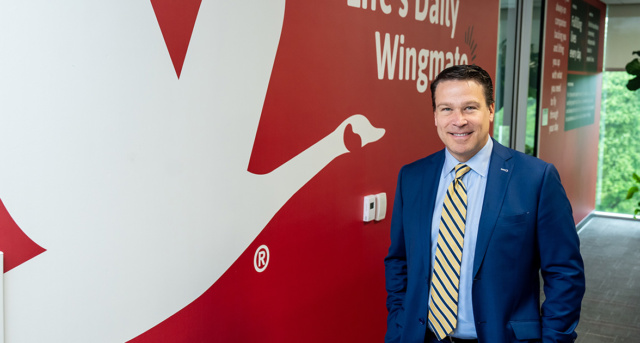
As president of Wawa, Inc., Brian Schaller, ‘97, MBA, is utilizing the education and values he gained at La Salle to see the company reach its greatest potential.
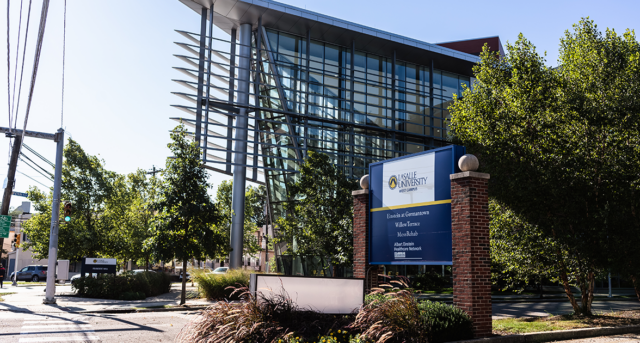
Ranked tied for 100, La Salle is one of just two Philadelphia-area institutions to be listed in the top 100 of the USNWR 2025 Best Business School rankings.